

Built in 1934 on Anishinaabe and Haudenosaunee land, P4W was the first and only federal prison for women in Canada for over sixty years. Before P4W, women from both Upper Canada (now Ontario) and Lower Canada (now Quebec) were imprisoned in the “Female Department” of Kingston Penitentiary. Until the closure of P4W in 2000, any woman sentenced to two or more years in prison would be sent to Kingston, whether from British Columbia, Newfoundland, or the Northwest Territories. Imagine being sent so far from home in the name of justice!
Living conditions at P4W were harsh, even by prison standards. Just four years after the prison opened, a government report called for its closure due to “disgraceful” conditions. More than 40 years later, another government report declared the prison “unfit for bears, much less for women.” Faith Davis, former President of the Elizabeth Fry Society for Kingston, described P4W in 2000 as an “Impossible building… Everything was made of metal and there was this enormous clanging all the time.”

The Elizabeth Fry Society of Kingston was established in 1949, offering services and support to criminalized women at P4W and beyond. Efforts were made to improve conditions at the prison, including garden plots where women could grow their own food with seeds and plants from the Kingston Penitentiary farm. But this was also a time of psychiatric abuse, including experiments with LSD and electroconvulsive therapy conducted on women at P4W, leading to a 1998 lawsuit.
The Native Sisterhood emerged at P4W in 1976, organizing powwows and other forms of ceremony on the prison grounds and sharing Indigenous teachings and mentorship.
The Strong Women’s Song has its roots in the solitary confinement unit at P4W. As Nancy Stevens explains,
My understanding, from one of the women I sing with and who went to P4W to work with the women there at that time, that this song emerged as a way of staying alive, of supporting each other in that hell hole. Many women in P4W lost their lives because of the horrendous conditions there. We sing this song to honour them, and all women
Nany Stevens on The Strong Woman's Song, 2014 via Ojibwe.net
The 1970s were a time of creative self-expression for people in prison at P4W and beyond. In 1972, prisoners launched a newsletter called Tightwire to “dissolve the barriers of physical imprisonment by sharing our attempts to free ourselves from the mental bondages that engulf us.” D. F. Martin wrote in a 1976 issue of Tightwire, “the whole [prison] system resembles a vast machine sucking people in one hand and spewing them out the other and then sucking them back in again – a self-generating mechanism, certainly not a human process.” Gail K Horii affirmed the power of art to disarm this machine:
The creative spirit within the woman's heart is the dominant path to survival. We are dying, and nearly devoid of life, we rush to the art form like shadows catching the body as we round the cornerstone. Dehydrated, waiting for life-fluid form, we reach for the pencil, the knitting needle, the clay, anything which will provide meaning and confirmation to our existence. With the most basic of tools, we fashion beauty and in that beauty, we are empowered and our woman-spirits survive.
Gayle K. Horii “The Art In/Of Survival,” 1994
In the 1980s, more programming was offered at P4W thanks to the advocacy of the Native Sisterhood and the Elizabeth Fry Society, including substance abuse programs, counselling for sexual abuse, and access to higher education.

Tragically, not everyone survived P4W. Between December 1988 and February 1991, seven women died by suicide in P4W. Six of these women were Indigenous.
Correctional Service Canada (CSC) appointed a Task Force on Federally Sentenced Women to investigate conditions at P4W and recommend change. The task force included representatives from the Native Women’s Association of Canada (NWAC), the Canadian Society of Elizabeth Fry Societies (CAEFS) and other groups. In 1990, they issued a report called Creating Choices, which once again called for the closure of P4W and the creation of a regional system of federal prisons for women, including a healing lodge for Indigenous women.
But P4W didn’t close overnight, and in the meantime, conditions in the prison were still intolerable. In April 1994, a conflict between prisoners and guards was suppressed by an all-male Institutional Emergency Response Team (IERT) who stripped the women naked and left them shackled on the floor for 6 hours. Security footage of the event was leaked to the media and broadcast on Contact TV, a Cablenet 13 program broadcast from local prisons, and the national news program, The Fifth Estate. Justice Louise Arbour led a 1996 commission to investigate the incident and once again recommended the closure of P4W. The prison closed for good in 2000.
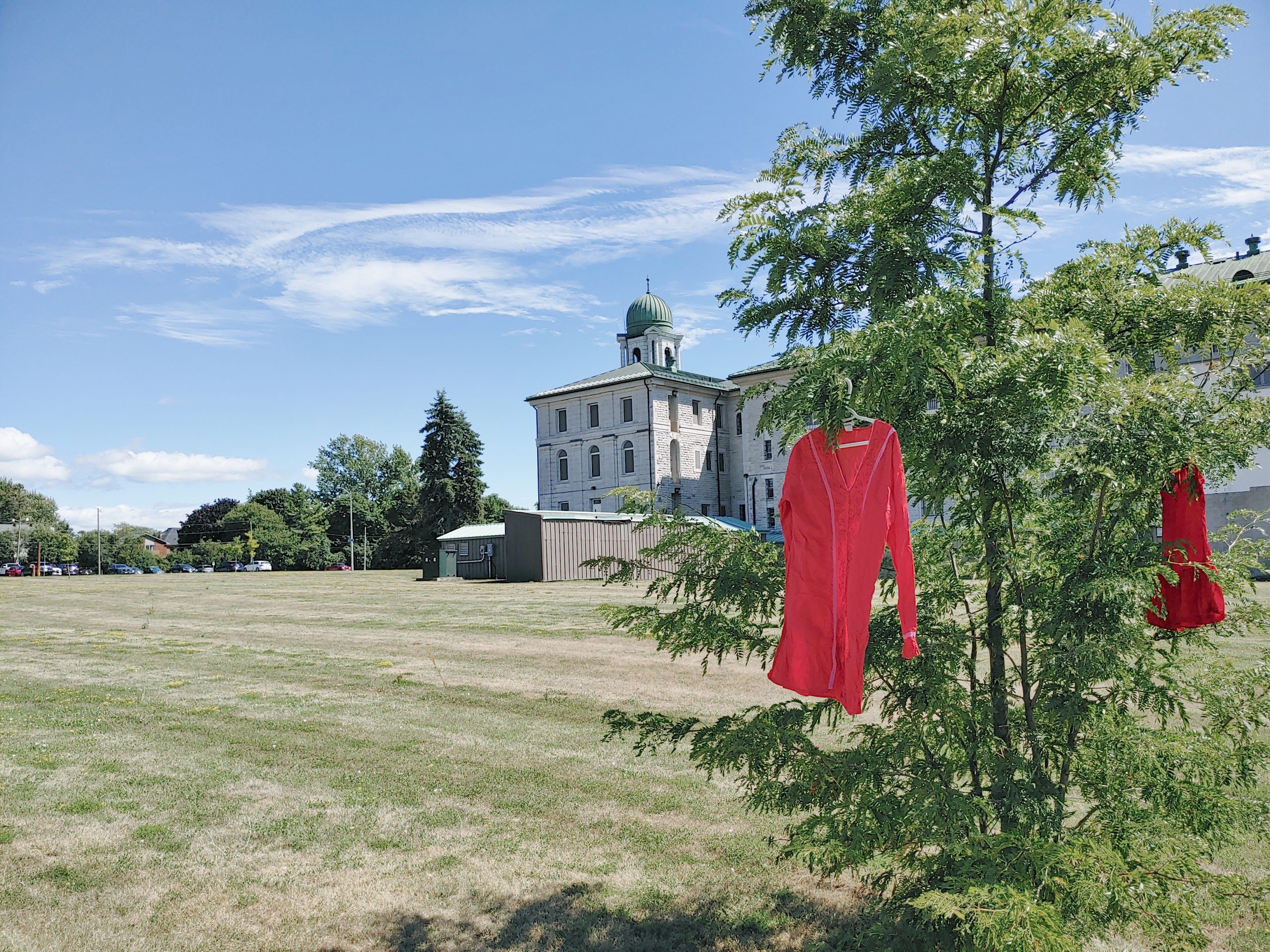
Today, Indigenous women make up less than 5% of the population and a full 50% of the prison population. The Correctional Investigator Ivan Zinger has called this situation “shocking and shameful for a country that has so many resources.” But resources are not everything. We also need a vision of justice as healing. Mohawk lawyer, activist, and educator Patricia Monture argued in 1995:
Healing expresses Aboriginal views on justice more clearly and accurately than any legal or justice words. Even the word justice has a negative connotation because the Canadian system of justice focuses on control, coercion and punishment. These are values that are very much contrary to traditional teachings. Healing more accurately describes a process that will return us to the place where we can recover Aboriginal methods of social control and social order. These methods are very much family based.
Patricia Monture, “Justice as Healing: Thinking About Change.” Native Law Centre, Summer 1995
Every year on Prisoners’ Justice Day (August 10), a group of women who were imprisoned at P4W, along with other formerly incarcerated people and their allies, gather for a healing circle to remember lost friends and loved ones. In addition to their annual healing circles, the P4W Memorial Collective has organized film screenings, solidarity letters, roundtable discussions, and other gatherings.
What will happen to P4W now that the prison has been closed for over 20 years? Queen’s University purchased P4W in 2007, intending to use the former prison for student housing or university archives. But black mould made the building unusable, so the prison sat empty for over ten years. In 2008, P4W was designated as a site of “cultural heritage value” protected under the Ontario Heritage Act. More recently, Siderius Developments Ltd. purchased the prison and the eight acres of land on which it stands in June 2018. Redevelopment plans include residential, retail, and office space.
How do you think P4W should be remembered?
The P4W Memorial Collective is working towards the creation of a healing garden and gallery space at the Prison for Women site. This project will contribute to a greater understanding of the historical heritage of the Prison for Women beyond the architectural features of the prison. In addition, it will facilitate healing for those impacted by the prison system, and disrupt negative stereotypes the general public holds about criminalized people.

The P4W Memorial Collective is a group of women ex-prisoners from the Prison for Women (P4W) who are working towards the creation of a permanent memorial garden and community space on the grounds of P4W, in Katarokwi/Kingston, Ontario.
Through our work we honour the women who lost their lives in P4W, and uplift the stories of those women who survived.